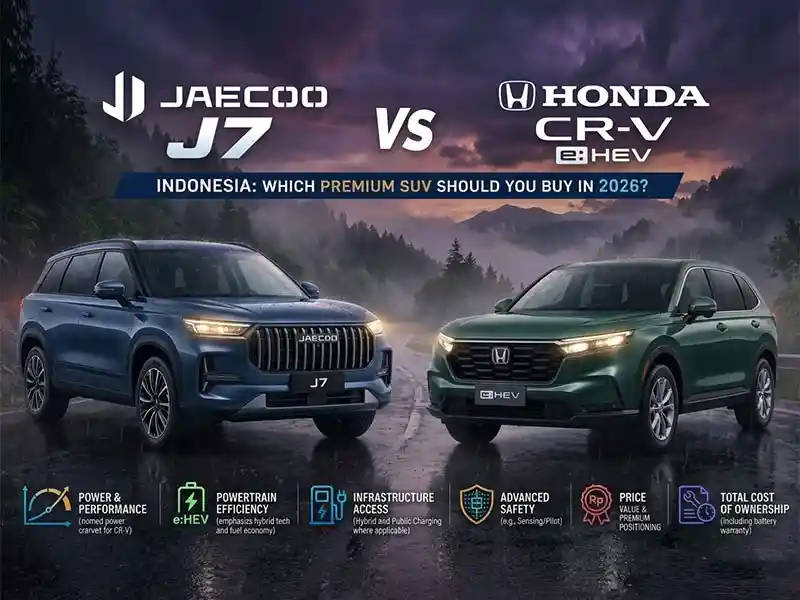
Autoini.com – The Jaecoo J7 vs Honda CRV comparison brings together two premium SUVs with different approaches to hybrid technology in Indonesia. The Jaecoo J7 SHS is a plug-in hybrid SUV with a large battery and external charging capability, while the Honda CRV e:HEV uses a self-charging hybrid system.
Both models offer five-seat interiors, advanced driver assistance systems, premium comfort features and electrified powertrains. However, the difference in price, battery size, charging technology and overall vehicle dimensions is significant.
The J7 SHS is positioned at a considerably lower price than the CRV e:HEV, while the Honda offers a larger SUV body and an established hybrid system that does not require external charging.
Here is a detailed comparison of the Jaecoo J7 price in Indonesia 2026, Honda CR-V pricing, performance, hybrid technology, battery, charging, interior, exterior, technology, safety, warranty and ownership considerations.
Jaecoo J7 vs Honda CRV: Full Comparison
| Jaecoo J7 SHS | Honda CRV e:HEV |
|---|---|
| PRICE & BASIC INFORMATION | |
| Model: Jaecoo J7 SHS | Model: Honda CRV e:HEV |
| Vehicle Type: Premium Plug-in Hybrid SUV | Vehicle Type: Premium Self-Charging Hybrid SUV |
| Indonesia Price: Approx. Rp514.9 million OTR Jakarta | Indonesia Price: Rp775 million OTR Jakarta |
| Higher Variant: J7 SHS specification | Higher Variant: CRV RS e:HEV at approx. Rp825.8 million OTR Jakarta |
| Seating: 5 seats | Seating: 5 seats |
| DIMENSIONS | |
| Length: Approx. 4,500 mm | Length: 4,691 mm |
| Width: Approx. 1,865 mm | Width: 1,886 mm |
| Height: Approx. 1,680 mm | Height: 1,681 mm |
| Wheelbase: Approx. 2,672 mm | Wheelbase: 2,701 mm |
| Wheels: 19-inch alloy wheels | Wheels: 19-inch alloy wheels |
| POWERTRAIN & PERFORMANCE | |
| Engine: 1.5L Turbocharged Petrol | Engine: 2.0L Petrol |
| Engine Technology: Turbocharged petrol engine with hybrid system | Engine Technology: 2.0L Atkinson-cycle petrol engine with e:HEV system |
| Electric Motor: Yes | Electric Motor: Yes |
| System Output: Up to 255 kW / 342 hp claimed | System Output: 207 PS |
| Combined Torque: Up to 525 Nm claimed | Electric Motor Torque: 335 Nm |
| Transmission: 1-speed DHT | Transmission: Electrical CVT system |
| Drive: Front-wheel drive | Drive: Front-wheel drive |
| 0-100 km/h: Approx. 7.3 seconds in published specification | 0-100 km/h: Not officially specified as a headline figure |
| Top Speed: 180 km/h | Top Speed: Not officially specified as a headline figure |
| HYBRID & BATTERY | |
| Hybrid Type: Plug-in Hybrid | Hybrid Type: Self-Charging Hybrid |
| Battery: 18.3 kWh lithium-ion | Battery: Approx. 1.06 kWh lithium-ion |
| External Charging: Yes | External Charging: No |
| Electric Driving: Yes | Electric-Assisted Driving: Yes |
| EV Range: Approx. 90 km WLTP | EV Range: Not applicable as a plug-in range |
| Alternative Range Figure: Approx. 106 km NEDC in published specifications | Charging: Battery charged through hybrid system and regenerative braking |
| CHARGING | |
| AC Charging: Up to around 6.6 kW | External AC Charging: Not required |
| DC Charging: Up to around 40 kW | External DC Charging: Not required |
| DC Charging Time: Approximately 30-80% in around 20 minutes under suitable conditions | Charging Method: Regenerative braking and hybrid system |
| EXTERIOR FEATURES | |
| LED headlights | Full LED headlights |
| LED daytime running lights | LED daytime running lights |
| Hidden door handles | Smart Entry system |
| Panoramic sunroof | Panoramic sunroof |
| Power tailgate | Hands-free power tailgate |
| Full-width LED rear light design | LED rear taillights |
| Power-folding exterior mirrors | Power-folding exterior mirrors |
| INTERIOR & COMFORT | |
| Infotainment: 14.8-inch central display | Infotainment: 9-inch display audio |
| Instrument Cluster: Digital display | Instrument Cluster: 10.2-inch TFT meter |
| Leather-trimmed interior | Leather-trimmed interior |
| Electric front seats | Electric driver seat |
| Ventilated front seats | Ventilated front seats on RS |
| Memory seat function | Driver memory function on applicable specification |
| Panoramic sunroof | Panoramic sunroof |
| Head-up display | Head-up display on RS |
| Wireless smartphone charging | Wireless smartphone charging |
| Sony premium audio system | Bose 12-speaker audio system on RS |
| TECHNOLOGY | |
| 14.8-inch infotainment display | 9-inch display audio with Google built-in |
| Connected vehicle technology | Honda CONNECT |
| Wireless charging | Wireless charging |
| Head-up display | Head-up display on RS |
| 540-degree panoramic camera | Multi-view camera assistance on selected specification |
| Vehicle-to-load capability on applicable specification | Digital Key functionality |
| ADAS & SAFETY | |
| Adaptive Cruise Control | Adaptive Cruise Control with Low-Speed Follow |
| Traffic Jam Assist | Lane Keeping Assist System |
| Lane Departure Warning | Collision Mitigation Braking System |
| Blind Spot Detection | Blind Spot Information |
| Forward Collision Warning | Road Departure Mitigation |
| Automatic Emergency Braking | Auto High Beam and Adaptive Driving Beam |
| Rear Cross Traffic-related assistance | Lead Car Departure Notification |
| 540-degree camera | Multi-view camera assistance on selected specification |
| 8 airbags in current Indonesian specification | 8 airbags |
| Electronic stability control | Vehicle stability control systems |
| WARRANTY | |
| Vehicle Warranty: Up to 6 years / 150,000 km | Vehicle Warranty: 3 years / 100,000 km |
| Hybrid Battery: 8 years / 160,000 km | High-Voltage Battery: 8 years / 160,000 km |
| Published service programme available | Honda authorised service network |
Jaecoo J7 SHS Overview
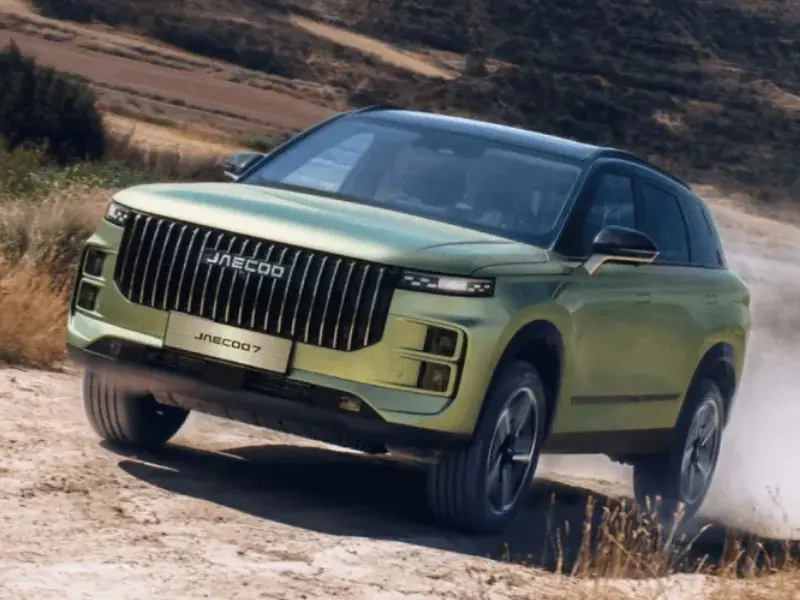
The Jaecoo J7 SHS is a plug-in hybrid SUV developed around a larger battery and electric driving capability. Its powertrain combines a 1.5-litre turbocharged petrol engine with an electric motor and an 18.3 kWh lithium-ion battery.
The large battery is the biggest difference between the J7 SHS and conventional self-charging hybrids. The vehicle can be externally charged and has a published electric range of approximately 90 km under WLTP testing.
This makes the J7 SHS particularly relevant for drivers who have access to home or workplace charging and want to use electric power for shorter daily journeys.
The J7 also places considerable emphasis on cabin technology. Features such as the 14.8-inch infotainment display, panoramic sunroof, ventilated seats, head-up display and 540-degree camera give it a technology-focused character.
ALSO READ
Chery J6 vs Omoda E5: Price, Specs, Range & Ownership Comparison
Honda CRV e:HEV Overview

The Honda CRV e:HEV uses Honda’s self-charging hybrid technology. Instead of relying on a large plug-in battery, the system uses a smaller battery that is charged through regenerative braking and the hybrid powertrain.
This means the CR-V does not require an external charging routine. Owners can simply refuel with petrol while the vehicle manages the hybrid battery automatically.
The 2026 Honda CR-V e:HEV starts at Rp775 million OTR Jakarta, while the CR-V RS e:HEV is priced at approximately Rp825.8 million OTR Jakarta.
The CR-V also has a larger overall body than the J7, making it a substantial five-seat SUV for family use and longer journeys.
Design & Exterior
The Jaecoo J7 SHS and Honda CRV have distinct exterior designs. The J7 uses a more technology-focused design with hidden door handles, a wide LED rear light signature and a modern front-end treatment.
The Honda CRV has a larger body and a more familiar SUV design. Its 4,691 mm length and 2,701 mm wheelbase make it longer than the J7.
Both SUVs use 19-inch alloy wheels and offer premium exterior equipment such as LED lighting, panoramic sunroofs and powered tailgates.
ALSO READ
Chery Omoda E5 vs Wuling Cloud EV: Top EVs Compared
Interior & Comfort
Inside, both SUVs provide five-seat cabins with premium equipment. The J7 SHS stands out with its large 14.8-inch central display, while the CRV uses a 9-inch display audio system supported by a 10.2-inch TFT instrument cluster.
The J7 SHS offers features such as ventilated electric seats, seat memory, panoramic sunroof, wireless charging, head-up display and Sony audio.
The CR-V provides leather-trimmed seating, electric seat adjustment, wireless charging and a panoramic sunroof. The RS e:HEV adds ventilated front seats, head-up display and a Bose 12-speaker sound system.
Technology & Connected Features
Technology is a major part of both SUVs. The J7 SHS uses a large central touchscreen and offers features such as a 540-degree camera, connected vehicle functions, wireless charging and vehicle-to-load capability on the applicable specification.
The Honda CRV uses Honda CONNECT and offers Google built-in through its display audio system. The RS version also provides additional technology and comfort equipment.
The difference is mainly in the way the two vehicles present technology. The J7 has a strong focus on a large central display and extensive digital equipment, while Honda combines its infotainment system with connected services and established vehicle controls.
Performance & Driving Experience
The J7 SHS uses a 1.5-litre turbocharged petrol engine combined with an electric motor. Its published combined system output can reach up to 255 kW, or approximately 342 hp, with up to 525 Nm of combined system torque.
These figures refer to the combined hybrid system rather than the petrol engine alone. The J7 SHS is also listed with a 0-100 km/h time of approximately 7.3 seconds and a top speed of 180 km/h in current published specifications.
The CRV e:HEV uses a 2.0-litre petrol engine and electric motor system producing 207 PS of total system output. Honda’s e:HEV technology is designed around smooth electric-assisted propulsion and efficient operation.
For everyday driving, the difference is not simply about maximum output. The J7 offers the additional flexibility of using its larger battery for electric driving, while the CRV automatically manages its smaller hybrid battery without requiring external charging.
ALSO READ
BYD Sealion 7 vs Tesla Model Y Indonesia: Which Should You Buy in 2026?
Hybrid System & Charging
The Jaecoo J7 SHS vs CRV e:HEV comparison becomes especially interesting when the battery systems are considered.
The J7 SHS has an 18.3 kWh battery and can be plugged into an external charger. Its published WLTP electric range is around 90 km. Current specifications also list AC charging of up to around 6.6 kW and DC charging capability of up to around 40 kW.
The CRV e:HEV has a much smaller hybrid battery and does not need external charging. Regenerative braking and the hybrid system keep the battery charged during normal driving.
For an owner with a home charger, the J7 can be used differently from a conventional hybrid. For an owner without charging access, the CRV’s self-charging approach may be more straightforward because charging infrastructure is not part of the daily routine.
Safety & ADAS
Both SUVs offer a comprehensive collection of active and passive safety technologies.
The J7 SHS includes features such as adaptive cruise control, traffic jam assist, lane departure warning, blind-spot detection, forward collision warning and automatic emergency braking. Its 540-degree camera system provides additional assistance during parking and low-speed manoeuvring.
The Honda CRV uses the Honda SENSING package. Depending on specification, it includes Collision Mitigation Braking System, Lane Keeping Assist System, Adaptive Cruise Control with Low-Speed Follow, Road Departure Mitigation, Auto High Beam and Lead Car Departure Notification.
Both models also provide multiple airbags and electronic stability-related safety systems.
Price & Ownership
The price difference is one of the most important considerations in this comparison.
The current Jaecoo J7 SHS is listed at approximately Rp514.9 million OTR Jakarta, while the Honda CRV e:HEV starts at Rp775 million OTR Jakarta. The CR-V RS e:HEV is priced at approximately Rp825.8 million.
This gives the J7 SHS a substantially lower purchase price. However, ownership costs should also be assessed based on annual mileage, fuel consumption, electricity usage, charging availability, maintenance, insurance and depreciation.
The J7’s plug-in hybrid system can be particularly useful when the battery is regularly charged. Shorter daily journeys can potentially use more electric power, reducing reliance on petrol.
The CRV e:HEV does not require external charging, which simplifies the ownership routine. This can be useful for buyers who regularly travel long distances or do not have convenient access to a home charger.
ALSO READ
Wuling Darion vs BYD M6 – Best Electric MPV Comparison in Indonesia
Warranty
JAECOO‘s current Indonesian programme lists vehicle warranty coverage of up to 6 years or 150,000 km and hybrid battery coverage of 8 years or 160,000 km.
Honda provides a 3-year or 100,000 km vehicle warranty for the CR-V and an 8-year or 160,000 km high-voltage battery warranty.
Warranty and service programme conditions can change, so buyers should confirm the exact terms with the authorised dealer before purchase.
Resale Value
Resale value is difficult to establish for the J7 because the model has a much shorter history in the Indonesian used-car market.
The Honda CRV has been sold in Indonesia for many years and therefore has a more established used-market presence. However, future resale prices for either hybrid SUV will depend on market demand, vehicle condition, mileage, maintenance history, future model updates and developments in Indonesia’s electrified vehicle market.
For buyers planning a long ownership period, warranty coverage, service availability, spare-parts support and expected running costs may be more useful considerations than attempting to predict a future resale price.
Which Should You Buy?
The choice between the Jaecoo J7 SHS and Honda CRV e:HEV depends on your driving pattern and priorities.
The Jaecoo J7 SHS is designed for buyers who want plug-in hybrid technology, a large battery, electric driving capability and extensive technology features at a substantially lower purchase price. Access to regular charging is an important part of getting the most from its PHEV system.
The Honda CRV e:HEV is designed for buyers who prefer a larger SUV with a self-charging hybrid system. It does not require external charging and combines hybrid technology with Honda’s established CRV platform and service network.
Before making a purchase, buyers should consider their budget, daily driving distance, charging availability, expected ownership period and the type of driving they normally do.
FAQs
What is the Jaecoo J7 price in Indonesia 2026?
The Jaecoo J7 SHS is currently listed at approximately Rp514.9 million OTR Jakarta. Final pricing can vary according to registration location, dealer programmes and promotions.
What is the Honda CRV price in Indonesia 2026?
The Honda CR-V e:HEV is priced at Rp775 million OTR Jakarta, while the CR-V RS e:HEV is priced at approximately Rp825.8 million OTR Jakarta.
What is the difference between Jaecoo J7 SHS and CRV e:HEV?
The Jaecoo J7 SHS is a plug-in hybrid with an 18.3 kWh battery and external charging capability. The Honda CRV e:HEV is a self-charging hybrid with a much smaller battery and does not require external charging.
What is the electric range of the Jaecoo J7 SHS?
The published electric range is approximately 90 km under the WLTP cycle. Some specifications quote around 106 km under the NEDC cycle. Actual range depends on driving conditions and usage.
Which has the larger battery, Jaecoo J7 or Honda CRV?
The Jaecoo J7 SHS has the larger battery by a substantial margin. It uses an 18.3 kWh battery, compared with approximately 1.06 kWh for the Honda CRV e:HEV.
Which is cheaper to own, Jaecoo J7 or Honda CRV?
Total ownership cost depends on fuel use, charging, maintenance, insurance, annual mileage and depreciation. The J7 has a lower purchase price and can use electric power for shorter trips when charged, while the CRV does not require external charging.
Conclusion
The Jaecoo J7 vs Honda CRV comparison highlights two different approaches to hybrid SUV ownership in Indonesia.
The Jaecoo J7 SHS combines plug-in hybrid technology, an 18.3 kWh battery, electric driving capability, strong published system output and extensive technology features with a significantly lower starting price.
The Honda CRV e:HEV offers a larger SUV body, self-charging hybrid technology, Honda SENSING safety features and an established presence in the Indonesian market, but at a considerably higher price.
For buyers comparing these SUVs, the most important factors are not limited to price or power. Charging access, daily driving distance, interior and technology preferences, warranty coverage, maintenance requirements and expected ownership period should all be considered before making a final decision.