Autoini.com – Choosing an electric SUV in Indonesia is no longer simply about finding the car with the biggest battery or the longest claimed range. Buyers now have to consider purchase price, charging convenience, safety technology, cabin comfort, after-sales support and long-term ownership costs.
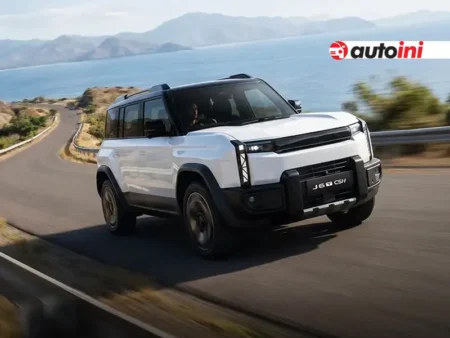
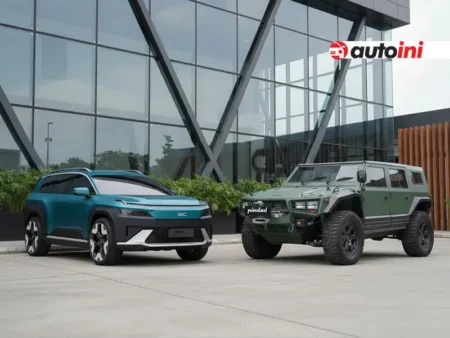
That makes the Chery J6 vs Omoda E5 comparison particularly interesting. Both models come from Chery and use LFP battery technology, but they have very different personalities. The J6 has a boxy SUV design, high ground clearance and an adventure-oriented character, while the Omoda E5 is a more urban-focused electric crossover with a lower entry price and a strong technology package.
As of September 2026, the Chery J6 starts at Rp565.5 million OTR Jakarta, while the Omoda E5 Pure starts at Rp425.5 million OTR Jakarta. The regular Omoda E5 starts at Rp505.5 million. These prices make the comparison especially relevant for Indonesian buyers who want to understand whether the J6’s additional cost brings enough practical benefits.
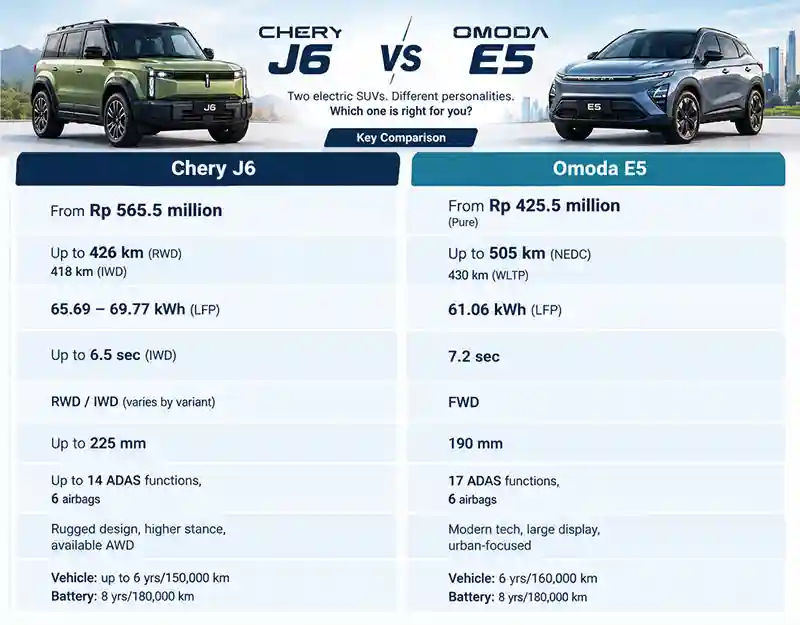
Chery J6 price Indonesia 2026 vs Omoda E5 price Indonesia 2026
The biggest difference between these two electric SUVs is their positioning. The Chery J6 price Indonesia 2026 starts at Rp565.5 million for the standard J6 RWD. The current J6 family also includes the J6T, J6 IWD, J6 Phantom Edition and J6 IWD Phantom Edition, with prices rising to Rp675.5 million for the top IWD Phantom Edition.
The Omoda E5 price Indonesia 2026 is considerably lower at the entry level. The E5 Pure starts at Rp425.5 million, while the regular Omoda E5 starts at Rp505.5 million OTR Jakarta. This gives buyers a lower-cost route into a Chery electric SUV.
| Chery J6 | Omoda E5 |
|---|---|
| Price: From Rp565.5 million OTR Jakarta Variants: J6, J6T, J6 IWD, Phantom Edition and IWD Phantom Edition Drive: RWD or Intelligent Wheel Drive depending on variant Character: Adventure-oriented electric SUV | Price: From Rp425.5 million OTR Jakarta Variants: Omoda E5 Pure and Omoda E5 Drive: Front-wheel drive Character: Urban-focused electric crossover SUV |
The price gap between the entry-level models is approximately Rp140 million. Therefore, buyers should not compare the two purely on features. The J6 is a larger and more rugged proposition, while the E5 offers a lower purchase barrier.
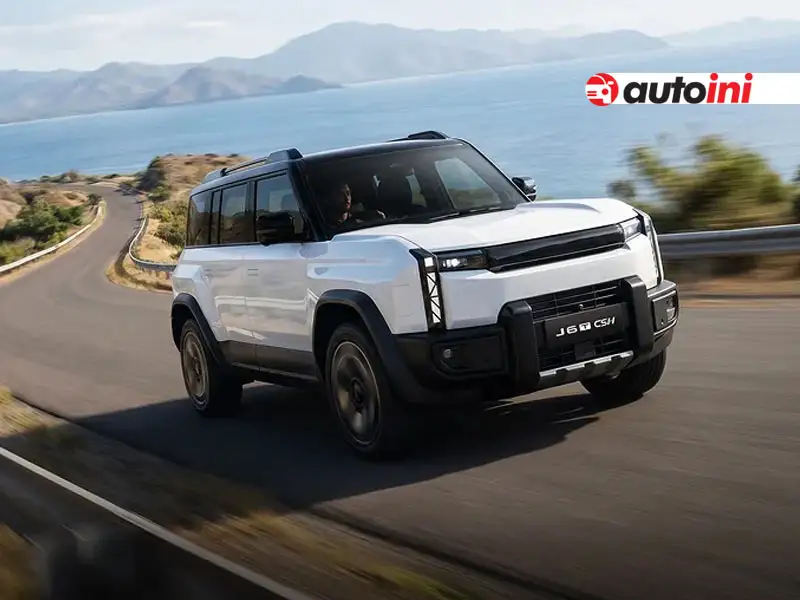

Chery J6 range vs Omoda E5 range
Range is one of the first things Indonesian EV buyers check, especially for people who regularly travel between Jakarta and other cities.
The official Chery information lists the J6 RWD with a claimed range of around 426 km, while the IWD version is listed at around 418 km NEDC. The J6 uses LFP batteries with capacities of 65.69 kWh for the RWD and 69.77 kWh for the IWD version.
The Omoda E5 range is quoted at up to 505 km under NEDC and 430 km under WLTP. Its battery capacity is 61.06 kWh. The different testing cycles are important because NEDC and WLTP figures should not be treated as directly equivalent.
| Chery J6 | Omoda E5 |
|---|---|
| Battery: 65.69 kWh RWD / 69.77 kWh IWD Claimed range: Around 426 km RWD / 418 km IWD NEDC Battery type: LFP V2L: Available Focus: SUV capability and varied driving conditions | Battery: 61.06 kWh Claimed range: Up to 505 km NEDC / 430 km WLTP Battery type: LFP V2L: Available Focus: Efficient urban and highway driving |
For everyday use, the important point is not simply which number is larger. Actual range can change with traffic, driving speed, air-conditioning use, passenger load, road conditions and driving style.
ALSO READ
Chery Omoda E5 vs Wuling Cloud EV: Top EVs Compared
Performance comparison: Chery J6 vs Omoda E5
The J6 has a clear performance advantage in its IWD configuration. The RWD J6 produces around 184 PS and 220 Nm, while the IWD/AWD version produces approximately 275 PS and 385 Nm. Chery quotes a 0-100 km/h time of around 6.5 seconds for the higher-performance configuration.
The Omoda E5 produces 201 hp and 340 Nm. It can accelerate from 0-100 km/h in approximately 7.2 seconds and has a claimed top speed of 175 km/h.
| Chery J6 | Omoda E5 |
|---|---|
| Power: Up to 275 PS Torque: Up to 385 Nm Drive: RWD/IWD depending on version Ground clearance: Up to 225 mm Driving character: Stronger off-road and rough-road capability | Power: 201 hp Torque: 340 Nm Drive: FWD Ground clearance: 190 mm Driving character: Smooth, responsive urban and highway driving |
The J6 is therefore more interesting for buyers who want an electric SUV that can handle rougher roads. The Omoda E5 is better aligned with normal city, suburban and highway driving.
Interior comparison: Chery J6 vs Omoda E5
Inside, both vehicles use modern digital technology, but their cabin philosophies are different.
The J6’s cabin follows the SUV’s adventure theme. Its higher driving position, boxy body and generous headroom give it a more traditional SUV feel. Higher versions add features such as ventilated or massaging seats, a large infotainment display and a premium Infinity audio system.
The Omoda E5 has a more futuristic dashboard design. One of its standout features is the large 24.6-inch curved display, while the Qualcomm 8155 cockpit platform supports the vehicle’s digital functions. The higher-specification E5 also gets an electric sunroof and electric tailgate.
For family users, both are five-seat SUVs. The J6’s upright shape gives the cabin a more rugged and spacious visual character, while the Omoda E5 feels more like a technology-focused urban crossover.
ALSO READ
BYD Sealion 7 vs Tesla Model Y Indonesia: Which Should You Buy in 2026?
Exterior comparison: Chery J6 vs Omoda E5
The exterior designs could hardly be more different.
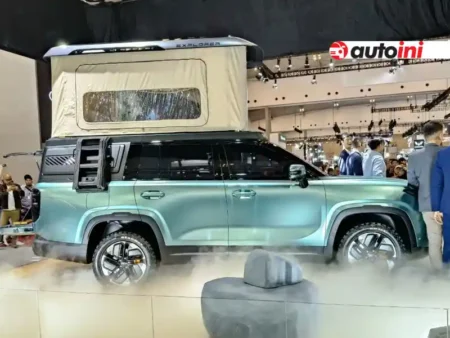
The J6 uses a distinctive box-shaped design with straight lines, high ground clearance and a rugged appearance. The current J6 measures around 4,406 mm in length and has a 2,715 mm wheelbase. Its aluminium H-arm multi-link suspension and up to 225 mm ground clearance are part of its adventure-oriented package.
The Omoda E5 is more aerodynamic and sporty. It measures 4,424 mm long, 1,830 mm wide and 1,588 mm high, with a 2,630 mm wheelbase and 190 mm ground clearance.
| Chery J6 | Omoda E5 |
|---|---|
| Design: Boxy, rugged and adventure-focused Length: 4,406 mm Wheelbase: 2,715 mm Ground clearance: Up to 225 mm USP: High stance and off-road-oriented design | Design: Futuristic, sporty crossover Length: 4,424 mm Wheelbase: 2,630 mm Ground clearance: 190 mm USP: Sleek urban styling and technology-focused design |
ADAS & Safety comparison
Safety is an important part of this comparison because both models offer advanced driver-assistance technology.
The Omoda E5 is equipped with 17 ADAS functions, six airbags, ISOFIX and an IP68-certified battery. The model has also received five-star safety ratings from Euro NCAP and ANCAP, according to information published by Chery Indonesia.
The J6 is available with up to 14 ADAS functions on specified variants. It also has six airbags, battery protection systems and a high ground clearance that is useful on uneven Indonesian roads.
Feature availability can vary by variant, so buyers should check the exact specification of the unit they are booking rather than assuming every J6 or E5 has the complete feature list.
Battery & charging comparison: Chery J6 range vs Omoda E5 range
Both models use LFP batteries, which are widely used in modern EVs because of their durability characteristics and suitability for everyday charging.
The J6 supports DC fast charging. Chery states that compatible versions can charge from 30% to 80% in about 30 minutes. The J6 also supports V2L with up to 3.3 kW output, allowing the vehicle battery to power compatible electrical equipment.
The Omoda E5 can charge from 30% to 80% in approximately 28 minutes under the manufacturer’s stated conditions. It also supports V2L and is equipped with an IP68-rated battery.
Charging infrastructure is becoming easier to access. In 2026, PLN reported 4,769 SPKLU units across 3,097 locations nationally during the Lebaran period. On the main Trans Sumatra-Java-Bali routes, 1,681 units were available across 994 locations.
ALSO READ
Wuling Darion vs BYD M6 – Best Electric MPV Comparison in Indonesia
Indonesia pricing, ownership cost and charging expenses
The purchase price is only one part of the ownership calculation. EV buyers should also consider home charging, public charging, insurance, tyres, scheduled maintenance and depreciation.
Electric SUVs generally avoid engine oil changes, spark plugs, fuel-system maintenance and several other ICE-related service items. Chery’s official after-sales information also provides free maintenance packages for its EV customers, subject to the applicable model and programme conditions.
For a simple illustration, a 61.06 kWh Omoda E5 battery would require roughly 61 kWh of energy for a theoretical full battery charge before charging losses. The J6’s larger battery requires more energy for a full charge. Actual electricity consumption depends on charging losses and driving efficiency.
Home charging is generally the most practical option for owners who have suitable electrical capacity. Public DC charging becomes more important during long-distance travel. PLN has also expanded its charging network significantly; it reported 4,655 SPKLU machines at 3,007 locations during 2025.
Because electricity tariffs and public charging prices can change, buyers should use the current PLN or charging-provider tariff when calculating their personal running cost rather than relying on an old fixed figure.
Warranty comparison
Warranty coverage is especially important for an EV because the battery is one of the most expensive components.
| Chery J6 | Omoda E5 |
|---|---|
| Vehicle warranty: Up to 6 years/150,000 km under current general after-sales terms Battery warranty: 8 years/180,000 km Maintenance: Model/programme dependent; Chery has offered up to 5 years/75,000 km for J6 EV Roadside assistance: Available under applicable programme | Vehicle warranty: 6 years/160,000 km Battery warranty: 8 years/180,000 km Maintenance: Up to 5 years/75,000 km under the published programme Roadside assistance: Available under applicable programme |
Chery’s current general after-sales page lists a six-year/150,000 km vehicle warranty, while model-specific Omoda E5 information lists six years/160,000 km. Earlier J6 launch programmes also advertised six years/160,000 km, so buyers should confirm the exact warranty terms attached to their purchase order.
Resale value discussion
Resale value is harder to measure than specifications because the current J6 and Omoda E5 used-car markets are still developing. There is not yet enough long-term, model-specific Indonesian transaction data to make a reliable depreciation prediction for either vehicle.
Several factors can influence future resale value: battery health, remaining battery warranty, service history, accident history, charging habits, availability of replacement parts, brand perception and the number of newer EV models entering the market.
The Omoda E5 has an advantage in terms of being an established model in Indonesia, with Chery reporting more than 4,510 retail sales since its February 2024 launch in information published in 2025. The J6 also established an early customer base, with Chery reporting more than 2,000 J6 EV deliveries before Lebaran 2025.
These sales figures show market adoption, but they should not be interpreted as a guarantee of future used-car prices.
Pros & Cons: Chery J6 vs Omoda E5
| Chery J6 | Omoda E5 |
|---|---|
| Pros: Higher ground clearance Available intelligent all-wheel drive Distinctive SUV design Strong torque in IWD version Adventure-oriented suspension and chassis V2L functionality Cons: Higher starting price Large exterior design may not suit every urban user Range varies by drivetrain and variant Some desirable features are limited to higher variants | Pros: Lower starting price Strong 201 hp/340 Nm output Up to 505 km NEDC claimed range 17 ADAS functions Modern digital interior Strong urban usability Cons: Lower ground clearance than J6 FWD-only configuration Less suitable for serious rough-road use Top features require the higher-priced version |
Which should you buy: Chery J6 or Omoda E5?
The answer depends on your priorities rather than simply choosing the vehicle with the longer specification sheet.
Choose the Chery J6 if you want a more rugged electric SUV, higher ground clearance, distinctive styling and the option of Intelligent Wheel Drive. It is particularly relevant for buyers who regularly travel on uneven roads, rural routes or want an EV with a more adventurous character.
Choose the Omoda E5 if your main use is city driving, commuting, family trips and highway travel. Its lower starting price, 201 hp motor, extensive ADAS package and claimed 505 km NEDC range make it a practical technology-focused alternative.
For a buyer with a strict budget, the Omoda E5 Pure is significantly cheaper than the J6. For someone specifically looking for the additional SUV capability of the J6, the higher purchase price needs to be considered alongside the vehicle’s ground clearance, drivetrain options and chassis characteristics.
Chery J6 vs Omoda E5: Key Takeaways
| Chery J6 | Omoda E5 |
|---|---|
| Starts at Rp565.5 million | Starts at Rp425.5 million |
| Up to 275 PS and 385 Nm in IWD version | 201 hp and 340 Nm |
| Up to around 426 km NEDC depending on version | Up to 505 km NEDC / 430 km WLTP |
| 65.69/69.77 kWh LFP battery depending on version | 61.06 kWh LFP battery |
| RWD or Intelligent Wheel Drive | FWD |
| Up to 225 mm ground clearance | 190 mm ground clearance |
| Up to 14 ADAS | 17 ADAS |
| Adventure-focused electric SUV | Urban-focused electric crossover |
FAQs
Is Chery J6 better than Omoda E5 for Indonesian roads?
The J6 has higher ground clearance and available Intelligent Wheel Drive, making its configuration more suitable for rough or uneven roads. The Omoda E5 is primarily designed as an urban and highway electric crossover.
What is the Chery J6 price Indonesia 2026?
The Chery J6 starts at Rp565.5 million OTR Jakarta as of September 2026. Higher variants, including IWD and Phantom Edition models, cost more. Prices can vary by city and promotional programme.
What is the Omoda E5 price Indonesia 2026?
The Omoda E5 Pure starts at Rp425.5 million OTR Jakarta, while the regular Omoda E5 starts at Rp505.5 million according to the current manufacturer listing.
What is the Chery J6 range on a full charge?
The Chery J6 range varies according to the drivetrain and battery configuration. Official figures list approximately 426 km NEDC for the RWD version and around 418 km NEDC for the IWD version.
What is the Omoda E5 range in Indonesia?
The Omoda E5 can travel up to 505 km according to the NEDC test cycle, while its WLTP figure is 430 km. Real-world range depends on speed, traffic, air-conditioning, road conditions and driving style.
How long does it take to fast charge the Chery J6?
Chery states that the J6 can charge from 30% to 80% in around 30 minutes using compatible DC fast charging equipment.
How long does it take to charge the Omoda E5 from 30% to 80%?
The Omoda E5 supports DC fast charging from 30% to 80% in approximately 28 minutes under the manufacturer’s stated conditions.
Conclusion
The Chery J6 vs Omoda E5 comparison highlights two different ways of approaching electric SUV ownership in Indonesia. The J6 focuses on SUV character, ground clearance, rugged styling and available Intelligent Wheel Drive. The Omoda E5 focuses more strongly on urban practicality, technology, ADAS equipment, performance and purchase affordability.
The Omoda E5’s lower starting price makes it an important option for buyers entering the electric SUV market with a tighter budget. The J6 asks for more money, but it offers a different type of vehicle with higher ground clearance and available all-wheel-drive capability.
Before making the final purchase, prospective buyers should compare the exact variant, current OTR price, financing offer, warranty conditions, home-charging installation and nearest authorised service centre. For Indonesian EV ownership, these practical factors can matter just as much as the headline range or power figure.