Autoini.com – Electric vehicle ownership in Indonesia is moving into a new phase. More electric cars are on the road, and the public charging network is expanding quickly to support them. For a new EV owner, however, charging can still seem confusing. There are different charger types, charging speeds, apps, payment systems and abbreviations to understand.
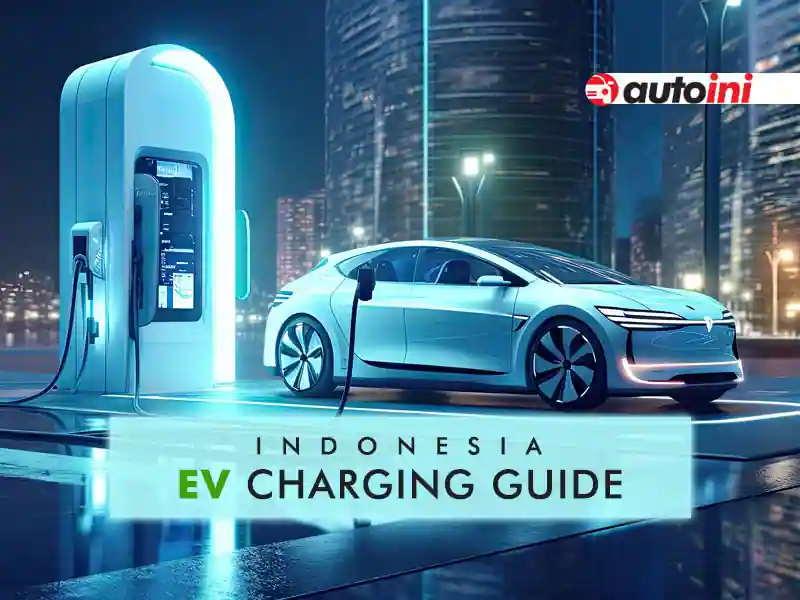
This Indonesia EV Charging Guide explains how the country’s charging system works, how much charging can cost, where to find public chargers and what EV owners should know before taking a long trip.
The growth is already visible in electricity consumption. PLN recorded 62.4 million kWh of electricity consumption at public EV charging stations during the first half of 2026. That figure was already higher than the 48.5 million kWh recorded during the whole of 2025, representing growth of around 28%.
EV Charging Cost Indonesia: How Much Does Charging Cost?
The EV Charging Cost Indonesia depends on where the vehicle is charged. Home charging is normally the most economical option because the owner pays the applicable household electricity tariff. Public charging is more expensive because the charging service can include an additional service fee.
For September 2026, the applicable PLN household electricity tariff for a 1,300–2,200 VA customer is Rp1,444.70 per kWh. Higher-capacity categories can have different tariffs, so the actual home-charging cost depends on the property’s electricity class.
For public fast charging, the electricity component can be charged using the applicable special-service tariff, while government regulations allow a maximum service fee of Rp25,000 per charging session for fast charging and Rp57,000 for ultra-fast charging.
| Charging Option | Typical Power | Best Use | Cost Level |
|---|---|---|---|
| Home AC charging | Up to around 7–22 kW | Daily and overnight charging | Lowest |
| Public AC charging | 7–22 kW | Malls, offices and destinations | Low to medium |
| DC Fast Charging | 25–150 kW+ | Quick top-ups and road trips | Medium |
| Ultra-fast charging | 100–150 kW+ | Highway and long-distance travel | Higher |
SPKLU Indonesia: What It Means and Where to Find One
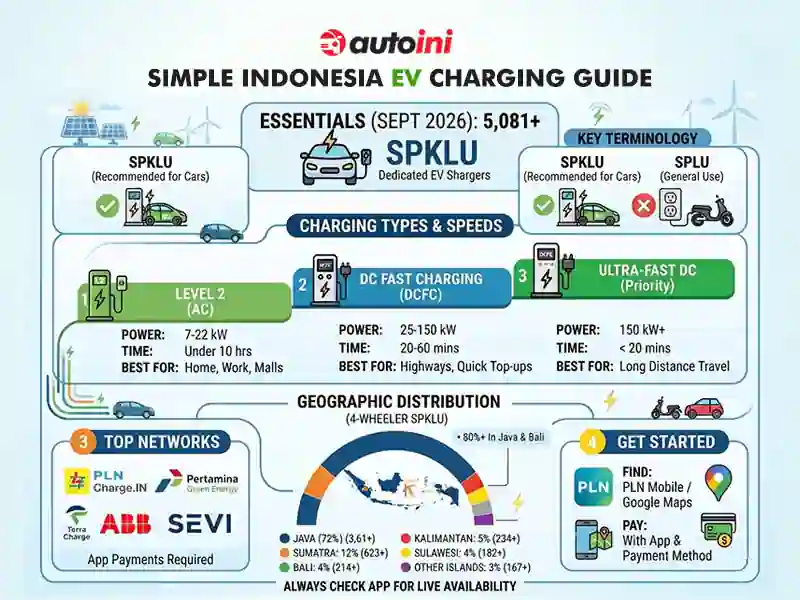
SPKLU Indonesia means Stasiun Pengisian Kendaraan Listrik Umum, or public electric vehicle charging station. These facilities are specifically designed for electric vehicles and are the correct places to charge an electric car in public.
Do not confuse SPKLU with SPLU. SPLU stands for Stasiun Penyedia Listrik Umum and is a general electricity supply facility. It is not a substitute for a vehicle charging station. EV owners should use a proper SPKLU or an approved private charging installation.
By September 2026, Indonesia had reached 5,081 four-wheel SPKLU units. PLN’s network has expanded dramatically from earlier years, with the 5,081-unit figure representing a more than 22-fold increase from 2021 levels.
The national distribution, however, is still uneven. Java has the largest network with 3,661 units, followed by Sumatra with 623 and Kalimantan with 234. Bali has 214, Sulawesi 182, Nusa Tenggara 105, Papua 36 and Maluku 26.
| Region | Four-Wheeler SPKLU Units |
|---|---|
| Java | 3,661 |
| Sumatra | 623 |
| Kalimantan | 234 |
| Bali | 214 |
| Sulawesi | 182 |
| Nusa Tenggara | 105 |
| Papua | 36 |
| Maluku | 26 |
Home Charging EV: The Most Convenient Option
For most owners, Home Charging EV will become the main charging method. Instead of making a special trip to a charging station, you can plug the vehicle in after returning home and leave it charging overnight.
The exact charging time depends on the car’s onboard charger, battery capacity and available household power. A higher electrical capacity can support a faster home charger, although installation requirements and local electrical conditions must be considered.
PLN has also supported home charging through its Home Charging System programme. The programme has included incentives such as reduced connection or additional-capacity costs and a 30% electricity discount for eligible overnight charging between 10:00 p.m. and 5:00 a.m. The specific promotional period and conditions should be checked before installation because programmes can change.
For an owner who drives mainly around the city, home charging can remove one of the biggest concerns about EV ownership: regularly finding a public charger.
ALSO READ
Is Jakarta’s Odd–Even Rule Fueling a Massive EV Buying Surge?
EV Charging Time: Understanding AC, Fast and Ultra-Fast Charging
EV Charging Time can range from several hours to less than 30 minutes. The biggest factor is charging power, but the vehicle’s maximum charging capability is equally important.
AC charging at around 7–22 kW is generally suited to overnight, workplace or destination charging. DC fast charging, at approximately 25–150 kW or more, is designed for quicker stops. Ultra-fast charging can reduce waiting time further on compatible vehicles.
Indonesia’s government development plan is increasingly focused on faster charging along important travel routes. The national roadmap for 2030 calls for 30,796 medium chargers, 19,538 fast chargers and 12,584 ultra-fast chargers. That would give ultra-fast charging a significant role in supporting intercity EV travel.
One important point is that a 150 kW charger does not automatically mean your car will charge at 150 kW. The vehicle’s battery and charging system determine the maximum power it can accept.
EV Charging Cost Indonesia: Networks, Apps and Payment
The charging experience in Indonesia involves both state-owned and private charging operators. PLN remains the largest network, supported by its Charge.IN ecosystem and EV services within PLN Mobile. Other energy companies and private charging providers are also developing stations at strategic commercial and travel locations.
PLN Mobile is particularly useful for EV owners because its EV Digital Services include Trip Planner, which helps identify SPKLU locations along a route, and AntreEV, which allows users to monitor charging queues in real time. PLN has also introduced EV-TAP electronic payment at selected charging points on Trans-Java routes.
Private charging locations can also be found at hotels, shopping centres, apartments, offices and other commercial properties. Some operators use their own mobile applications, so having more than one relevant charging app can be useful during long journeys.
SPKLU Indonesia: What EV Drivers Should Know Before a Road Trip
The rapid growth of SPKLU Indonesia does not mean every part of the country has the same charging coverage. Java remains by far the strongest market, while chargers are less common across several outer-island regions.
This makes route planning especially important when travelling outside major cities. Do not simply search for the nearest charger after the battery becomes low. Check the route before departure, identify charging points and keep an alternative station available.
During the 2026 Eid travel period, PLN provided 1,681 SPKLU units at 994 locations across the main Trans-Sumatra, Java and Bali routes. PLN also deployed 15 mobile SPKLU units at strategic locations as an additional emergency measure.
Demand is also rising quickly. During the 2026 Eid period, SPKLU transactions increased more than four times compared with the previous year. This is a useful reminder that a charger can be available in a location but still be occupied when you arrive.
ALSO READ
Chery J6T CSH Debuts at GIIAS 2026 with REEV Technology
Home Charging EV: Simple Tips to Reduce Charging Hassle
Use home charging for regular daily driving whenever possible and save public fast chargers for situations where speed matters. Avoid charging only when the battery is nearly empty, particularly before a long journey.
Before installing a home charger, check your home’s electrical capacity and the vehicle’s maximum AC charging rate. There is little benefit in installing a very high-powered charger if the car cannot use that power.
For road trips, leave some battery reserve and plan your next charging stop before reaching a low state of charge. This is especially important in regions where the next SPKLU may be considerably farther away.
Frequently Asked Questions
What is the difference between SPKLU and SPLU?
SPKLU is a dedicated public electric vehicle charging station. SPLU is a general public electricity supply facility and should not be treated as a replacement for a proper EV charger.
How much does EV charging cost in Indonesia?
The EV Charging Cost Indonesia depends on the electricity tariff, battery size and charging location. Home charging generally costs less, while public fast and ultra-fast charging can include additional service fees.
How many SPKLU are there in Indonesia in 2026?
As of September 2026, Indonesia has approximately 5,081 four-wheel SPKLU units. Java has the largest share with 3,661 units, while the network continues to expand into Sumatra, Kalimantan, Sulawesi and other regions.
How long does it take to charge an electric car?
EV Charging Time depends on the battery and charger. AC charging can take several hours, while compatible DC fast and ultra-fast chargers can significantly reduce the time needed for a useful top-up.
Is Home Charging EV cheaper than public charging?
In most cases, yes. Home Charging EV uses the applicable household electricity tariff, while public charging can include electricity charges and a separate service fee.
How should I plan an EV road trip in Indonesia?
Check SPKLU locations along the complete route, verify connector availability and monitor the latest station status before travelling. Keep a backup charging location in case the first station is busy or unavailable.
Conclusion
The Indonesia EV Charging Guide shows that charging infrastructure is developing at a much faster pace than it was only a few years ago. Indonesia now has 5,081 four-wheel SPKLU units, while PLN recorded 62.4 million kWh of public charging consumption in just the first six months of 2026.
But the next stage will be about more than simply adding chargers. The country needs better geographic coverage, more fast and ultra-fast stations and reliable digital information about availability. The government’s roadmap targets 9,633 SPKLU units in 2026 and 62,918 by 2030, showing the scale of infrastructure planned for the coming years.
For today’s EV owner, the formula is straightforward: use home charging for everyday driving, use SPKLU for longer trips, check the charging speed your car can actually accept and plan ahead when travelling outside major EV markets. With these simple habits, electric-car charging in Indonesia can be considerably easier and more predictable.