Paying vehicle tax is a regular responsibility for every car and motorcycle owner in Indonesia. However, the amount shown on a tax bill can sometimes be confusing because it may include several different charges.
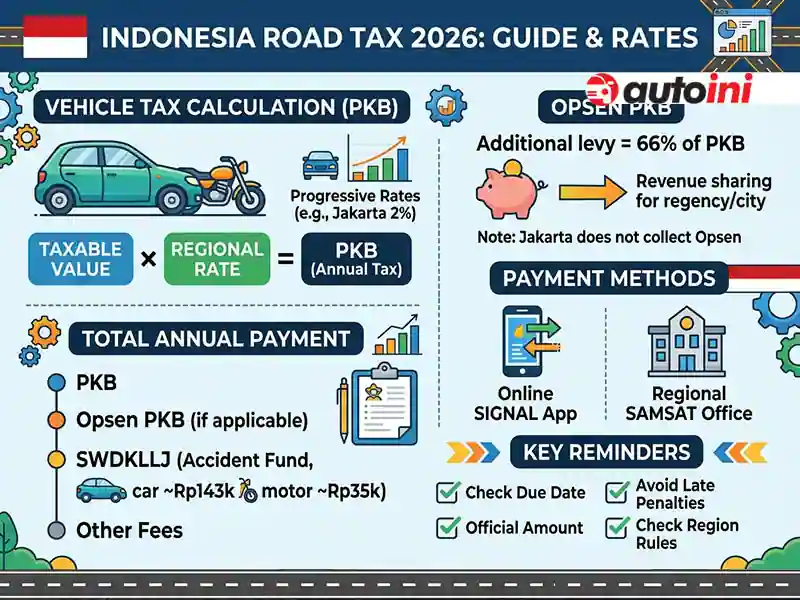
The Indonesia Road Tax Guide 2026 system mainly revolves around Pajak Kendaraan Bermotor (PKB), while some regions also apply Opsen PKB. The exact amount depends on the vehicle, ownership, region and local regulations.
A major point to understand in 2026 is that the national tax framework allows an Opsen PKB of 66% of the PKB amount, with the collection mechanism designed to share revenue with the regency or city government. However, the system does not apply in exactly the same way everywhere. Jakarta does not collect Opsen PKB because it is a province-level autonomous region that is not divided into autonomous regencies or cities.
Indonesia Road Tax 2026: Key Points
| Key Point | What You Need to Know |
|---|---|
| Main vehicle tax | PKB (Pajak Kendaraan Bermotor) is the main annual tax paid by vehicle owners. |
| PKB rate | The rate varies by province, vehicle and ownership. Jakarta applies 2% for a first vehicle, with progressive rates for additional vehicles. |
| Opsen PKB | Opsen PKB is generally calculated at 66% of the PKB amount under the national framework. |
| Jakarta exception | Jakarta does not collect Opsen PKB because of its special administrative structure. |
| Other charges | The annual payment can also include SWDKLLJ and applicable registration-related charges. |
| Tax period | PKB is generally assessed for a 12-month period according to the vehicle’s registration period. |
| Payment options | Eligible vehicle owners can use digital services such as SIGNAL for PKB payment and annual STNK validation. |
| Different provinces | Vehicle-tax rates and implementation can differ between provinces, so owners should check their local tax authority. |
| Electric vehicles | EV tax treatment can differ from petrol and diesel vehicles depending on applicable national and regional incentives. |
| Used cars | Buying a used car does not remove outstanding vehicle-tax obligations. Buyers should check the tax and registration status before purchase. |
| Late payment | Late payment can result in administrative penalties, although temporary regional tax-relief programmes may sometimes be available. |
| Best practice | Check the official tax amount and due date before payment rather than relying on old online calculators. |
PKB Rates Indonesia and Indonesia Vehicle Tax Calculation
The easiest way to understand PKB rates Indonesia is to start with the basic formula: the taxable value of the vehicle is multiplied by the applicable regional PKB rate.
The taxable value is not simply the price you paid for the car. Government regulations use the vehicle’s official sales value and weight-related factors when determining the tax base. Regional authorities can then apply their approved rates.
For example, Jakarta currently applies a 2% PKB rate for a person’s first vehicle. The rate rises progressively to 3%, 4%, 5% and 6% for the second, third, fourth and fifth vehicle onward under its current rules.
PKB Rates Indonesia: How Ownership Changes Tax
PKB rates Indonesia can be higher when the same taxpayer owns several vehicles. This is known as progressive taxation.
In Jakarta, ownership is considered using the owner’s name, national identification number and/or address. This means buying another vehicle under the same ownership details can affect the applicable rate.
Other provinces may have different rates and policies. Therefore, readers should not assume that the tax percentage in Jakarta automatically applies to Bandung, Surabaya, Semarang or other cities.
PKB Rates Indonesia and the 2026 Opsen System
The introduction of Opsen is one of the most important things to understand about PKB rates Indonesia in 2026.
Under the national framework, Opsen PKB is set at 66% of the outstanding PKB. It is collected together with the vehicle tax rather than as a completely separate annual process.
Importantly, this does not mean every Indonesian motorist simply pays 66% more than before. The overall regional tax structure and local regulations determine the final amount. The government also designed the system to improve revenue sharing between provincial and regency/city governments.
Indonesia Vehicle Tax Calculation: What You Actually Pay
Understanding Indonesia vehicle tax calculation requires looking beyond the basic PKB figure.
A typical annual vehicle-tax payment can involve:
| Component | What It Means |
|---|---|
| PKB | Main tax on ownership or control of the vehicle. |
| Opsen PKB | Additional levy applied under the regional system where applicable. |
| SWDKLLJ | Mandatory contribution related to road traffic accident protection. |
| STNK-related fees | Applicable mainly to registration and document services. |
| Other charges | May apply depending on the type of transaction or service. |
SWDKLLJ is separate from PKB. For reference, the mandatory contribution listed for a car is around Rp143,000, while the motorcycle amount can be around Rp35,000, depending on the vehicle category.
Indonesia Vehicle Tax Calculation: A Simple Example
For Indonesia vehicle tax calculation, suppose a vehicle has a taxable base of Rp200 million and the applicable PKB rate is 2%.
The basic PKB would be:
Rp200 million × 2% = Rp4 million
If the vehicle falls under a regional system where a 66% Opsen applies to that PKB amount, the Opsen would be:
Rp4 million × 66% = Rp2.64 million
The PKB plus Opsen would therefore be Rp6.64 million before other applicable charges.
This is only an illustration, not an actual tax quotation. The real amount can differ because the official taxable value, regional regulation and vehicle details determine the final bill.
Indonesia Vehicle Tax Calculation: Why Your Bill Can Differ
Your neighbour may own a similar-looking car but pay a different amount. This is possible because vehicle tax is affected by several factors.
- Vehicle type and classification
- Official taxable value
- Engine or vehicle characteristics
- Ownership status
- Number of vehicles under the same owner
- Province or local government
- Available regional incentives or reductions
- Outstanding tax or administrative penalties
For this reason, using an online calculator that is not connected to the relevant government database may only provide an estimate.
ALSO READ
BYD Sealion 7 vs Tesla Model Y Indonesia: Which Should You Buy in 2026?
Indonesia Vehicle Tax Payment: Online Options in 2026
Indonesia vehicle tax payment has become considerably easier with digital services.
The national SIGNAL application allows eligible vehicle owners to pay PKB, pay SWDKLLJ and complete annual STNK validation through a smartphone. The system connects vehicle information with population and regional tax databases.
The process generally requires the vehicle registration number and other identification details. After the amount is displayed, the user can generate a payment code and use an available banking or payment channel.
Indonesia Vehicle Tax Payment: What You Need
For Indonesia vehicle tax payment, owners should make sure their vehicle and personal information are correctly registered.
Commonly required information includes:
- Vehicle registration number
- Owner’s identification details
- Vehicle chassis-number information where required
- Valid registration records
- Payment method supported by the selected service
For digital payments, the exact requirements can vary according to the vehicle and regional system.
Indonesia Vehicle Tax Payment: When Should You Pay?
Indonesia vehicle tax payment is generally linked to the vehicle’s registration period. In Jakarta, PKB is imposed for 12 consecutive months from the vehicle’s registration date and is paid in advance.
Some regional tax offices also remind motorists that payment can be made before the due date. In Central Java, for example, the regional tax authority has advised that vehicle tax can be paid 30 days before its due date.
Paying early is a simple way to avoid forgetting the deadline.
Indonesia Vehicle Tax Payment: What Happens If You Are Late?
Late payment can result in administrative penalties, depending on the applicable regional rules and the length of the delay.
Some provinces periodically introduce tax-relief programmes. Jakarta, for example, announced a 2026 policy providing administrative-sanction relief for certain PKB and BBNKB obligations. Such programmes are temporary, however, and should not be treated as a permanent exemption.
Indonesia Vehicle Tax Rules: Jakarta in 2026
The Indonesia vehicle tax rules are not identical in every province.
Jakarta provides a useful example. Its current PKB rate for a person’s first vehicle is 2%, with progressive rates for additional vehicles. Jakarta also does not collect Opsen PKB because its administrative structure differs from provinces divided into autonomous regencies and cities.
The regional government has also published a specific SKPD PKB document for 2026, confirming that vehicle-tax administration continues under the current year’s regional framework.
Indonesia Vehicle Tax Rules: Other Provinces Can Differ
The most important point about Indonesia vehicle tax rules is that there is no single final amount that applies nationwide.
The national government establishes the framework, while provincial and local governments implement their own tax regulations within that framework.
This is why someone searching for “car tax in Indonesia” should always check the province where the vehicle is officially registered.
Indonesia Vehicle Tax Rules: Electric Cars in 2026
Electric vehicles require additional attention when looking at Indonesia vehicle tax rules.
Government policy has provided various incentives for electric vehicles, but buyers should not assume that every EV automatically receives the same tax treatment in every province.
The national EV policy also includes domestic-content requirements, with the minimum TKDN requirement scheduled at 40% through 2026, rising to 60% for 2027-2029 and 80% from 2030 onward under the applicable framework.
For an EV owner, the best approach is to check the current regional tax bill rather than relying on older promotional information.
Indonesia Vehicle Tax Rules: Used Cars and Ownership
Buying a used car does not remove the obligation to pay annual PKB.
However, ownership administration is important. In 2026, authorities have clarified that a vehicle can still be processed for tax payment in certain cases even when the new owner does not have the previous owner’s KTP, although the authorities encourage completing the ownership transfer process.
For buyers of used cars, checking outstanding tax, registration status and ownership documents before completing the purchase can prevent unpleasant surprises.
Indonesia Vehicle Tax Rules: What Owners Should Remember
The most practical Indonesia vehicle tax rules can be summarised simply:
- Check the official due date on your vehicle documents.
- Confirm the tax amount using an official regional service.
- Check whether Opsen applies in your area.
- Include SWDKLLJ and other applicable charges in your budget.
- Keep your ownership information updated.
- Do not rely on old tax calculators because regional policies can change.
Indonesia Road Tax 2026: Final Takeaway
The Indonesia Road Tax 2026 system is easier to understand once PKB, Opsen and registration-related charges are separated.
The biggest change for many motorists is the implementation of the 66% Opsen PKB framework, although the actual effect on a vehicle owner’s final bill depends on the regional tax structure. Jakarta is a notable exception because it does not collect Opsen PKB.
For motorists, the safest approach is simple: check the official tax amount for your vehicle and province, pay before the deadline and keep the registration details updated. With digital services such as SIGNAL now supporting annual PKB payment and STNK validation, paying vehicle tax in Indonesia is becoming more convenient.
Frequently Asked Questions About Indonesia Road Tax 2026
What are the current PKB rates Indonesia in 2026?
PKB rates Indonesia vary by province and vehicle ownership. In Jakarta, the current rate for a person’s first vehicle is 2%, while progressive rates apply to additional vehicles.
How does Indonesia vehicle tax calculation work?
Indonesia vehicle tax calculation starts with the official taxable value of the vehicle and the applicable PKB rate. Where applicable, Opsen PKB is then calculated at 66% of the PKB amount under the national framework.
How can I make Indonesia vehicle tax payment online?
For Indonesia vehicle tax payment, eligible owners can use the SIGNAL application to pay PKB and SWDKLLJ and complete annual STNK validation digitally.
Are Indonesia vehicle tax rules the same in every province?
No. Indonesia vehicle tax rules operate under a national framework, but provincial regulations can determine applicable rates, incentives and implementation. Therefore, vehicle owners should check the rules for the province where their vehicle is registered.
Does every vehicle have to pay Opsen PKB?
No. The 66% Opsen PKB framework does not mean every province collects it in the same way. Jakarta, for example, does not collect Opsen PKB because of its administrative structure.
Is electric vehicle tax the same as petrol car tax?
Not necessarily. EVs can receive different treatment depending on national and regional policies. Owners should check the current tax assessment for their specific vehicle and registration location rather than relying on general EV tax claims.